1. In those hunting societies where males dominate in the political economy, such as among the Plains Indians and the Inuit, men on average live longer than women because their lives are easier.
1. true
2. false
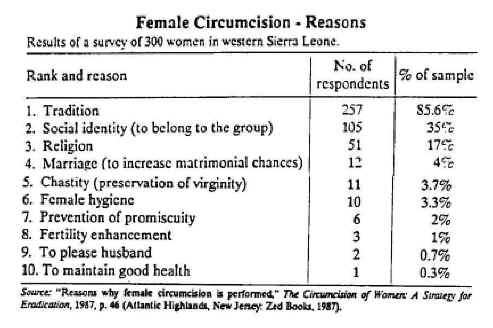
2. Which of the following statements is most correct, given the above table?
1. More women in Sierra Leone practice circumcision as a ritual to please present and future husbands than as an expression of their social or ethnic identity.
2. The most significant reason for women practicing circumcision is to enhance their marriage prospects.
3. The three most significant reasons for practicing circumcision in Sierra Leone are to control female sexuality, to follow religious prescriptions and to enhance a woman’s marital prospects.
4. While a variety of reasons may be given by a small minority of women, the most common reason for which women in Sierra Leone undergo circumcision is simply because it is what is generally done in that society.
3. According to Ernestine Friedl,
1. male power in foraging societies derives from the greater physical strength of men.
2. male power in foraging societies derives, in large part, from the fact that hunting places men in larger networks of reciprocity than gathering does for women.
3. the relative status of women is lowest in those foraging societies where women are burdened with the responsibility of providing the majority of food for the group.
4. women in all hunting societies are equal to men.
4. Melvin Konner reports that 57 of the 94 studies of aggression he reviewed showed "statistically significant sex differences" in aggressive behavior. In 52 of the 57 studies that showed gender differences in aggressive behavior, boys were found to be more aggressive than girls, while in 5 of the studies, girls were found to be more aggressive than boys. Which of the following conclusions can most reasonably be drawn from Konner's research?
1. Males are naturally more aggressive than females.
2. Males were found to be more aggressive than females in a larger number of studies because females are naturally more submissive than males and are likely to become timid in the presence of males.
3. Mary Daly is right: women need to be in classes without men, because men will inevitably dominate discussions and inhibit women from expressing themselves.
4. The relative degree of aggressiveness between males and females is situational, as illustrated by the fact that in nearly half the studies reported by Konner either no difference in aggressiveness was found or women were more aggressive than males.
5. 1 and 2
5. The relative status of women among the settled agricultural Ju/'hoansi has declined because
1. the relative economic contribution of males has increased, while that of females has decreased.
2. males own the productive property (farmlands and herds).
3. women's labor is limited to the domestic economy.
4. all of the above.
6. Which of the following sequences most correctly portrays a Cultural Materialist direction of causality (I → S → SS)?
1. post-industrial economy - Roe vs. Wade - two-income families
2. net hunting as the basic subsistence strategy – negative attitudes towards rape – male/female participation in the hunt
3. declining bison population on the Great Plains – intertribal warfare – warrior ethic
4. Yanomamo polygyny –belief in male supremacy – female infanticide
7. The Iroquois Indians of the eastern woodland region of the U.S. (the upstate New York area) are one of the best-known societies in which women achieved relatively high status. Which of the following statements is NOT true regarding the Iroquois?
1. Agriculture, the management of the village economy and the appointment of clan chiefs were largely in the hands of women.
2. Female sexual permissiveness was accepted, and violence against women was uncommon.
3. Because the Iroquois were matrilineal and matrilocal and women were in charge of the village economy, warfare was less intense among the Iroquois than among most other Indian groups. Five of the Iroquois tribes even joined together in a league in order to promote peace and limit warfare.
4. A woman's life was economically valued more highly than a man's life.
5. More wealth was given as compensation to a family for killing a woman in that family than for killing a man.
6. The Iroquois were reported to have celebrated more at the birth of a girl than at the birth of a boy, because a girl would contribute more to the future growth of the village.

(The two Mbuti groups are net hunters; the Efe-Lese are archers.)
8. The above table (taken from Bailey and Aunger, "Net Hunters vs. Archers: Variations in Women's Subsistence Strategies in the Ituri Forest") shows that due to the higher exchange value of meat in the net-hunting area, women in net-hunting bands can earn much more total food calories (and thus contribute more to the support of the band) through hunting than by working in village gardens. Following Friedl's thesis, this would likely give net-hunter women a higher relative social status than archer women, who, for economic reasons, are better off not hunting, but working in village gardens.
1. true
2. false
9. Which of the following would be considered a part of structure by Marvin Harris?
1. net hunting among the Mbuti Pygmies
2. Mary Daly’s book, Gyn-Ecology
3. Ecofeminism
4. polygamous marriage
5. The Gospel according to Mary Magdalene.
10. According to Goldstein ("When Brothers Share a Wife"),
1. Tibetan polyandry is a form of marriage which enables ambitious males to exploit poor women who, because they do not have very large dowries, are unable to marry into prosperous and reliable families.
2. Tibetan polyandry occurs primarily where there is a shortage of land and where brothers are economically better off sharing the family land rather than dividing it into smaller, uneconomic parcels. Under such conditions, one wife will also yield less children than several wives. This limits the number of people that need to be supported on the limited available land and who will subsequently inherit the land in the future.
3. Tibetan polyandry is a form of marriage in which several wealthy males from different families increase their individual wealth by combining their land into a single parcel of land and agreeing to share a single wife in order to reduce the number of children that they will have to support.
4. Tibetan polyandry occurs in upper class families where: (1) no sons are born, (2) sufficient land exists within the family to support several males and (3) having several males in the family provides greater support for the girls' parents.